For some people, knowing how to run a business, how to manage it, and how to sustain it is all new territory. For example, if you want to start a business and are unsure how to conduct a proper product test with the public. I’ll break down Eric Ries’s book titled The Lean Startup. Ihope that after reading my article, you’ll at least gain a general understanding of how to start a business using the lean startup approach.
Starting a business is a daunting prospect for most people, with so many uncertainties lying ahead. Will people buy our product? Will our product be able to compete with the competition? And there are many more questions that arise when we want to start a business. Everyone wants their business to succeed and make a lot of money. But in reality, more people fail than succeed. If more people fail, is there no way to increase the chances of success? Is it not worth trying at all?
The Lean Startup is a concept popularized by Eric Ries; it is a method for launching startups based on a scientific approach. Eric introduced the idea that when we launch a startup, we should treat it like conducting an experiment in a lab. Everything must be measurable, and we are required to work within a measurable system. I find Eric’s approach quite compelling because I believe. That while we cannot control the outcomes we will achieve, we can control the process we follow.
“A startup is a human institution designed to create a new product or service under conditions of extreme uncertainty.”
Vision
Anyone looking to start a business always faces uncertainty—feeling unsure of how to get started, how to create a product that meets people’s needs, and so on. But of course, you have an initial idea (hypothesis) about a product that people need. Do you need to wait until you’ve created the perfect product before selling it to the public? In this section, we’ll explore how to refine your idea and establish a work culture.
The fundamental concept of the lean startup is based on a lean manufacturing method introduced by Taiichi Ohno and Shigeo Shingo, who were among those who developed Toyota’s work culture. The philosophy of lean manufacturing aims to maximize efficiency and add value for customers. Toyota optimized workers’ movements and implemented group work during production to ensure that production errors could be corrected quickly.
Entrepreneurial management
When starting a startup, there are two opinions that people hear most often. The first is that a startup is a fledgling company whose establishment requires very detailed planning and has five-year goals that must be achieved no matter what the circumstances. The second opinion is “Just do it”; they believe that a startup doesn’t need a plan and that, over time, they will learn how to run a company effectively. However, more startups fail than succeed using these two methods. The first method has the drawback of being unable to adapt to changes, while the second method has the weakness of lacking a clear system, so that every startup member doesn’t know what to do.
A startup must have a management team—yes, a management—but the approach it takes must differ from that of a company that has been firmly established for years. A startup must build a management team capable of weathering conditions of uncertainty. Here are some strategies that can be applied to startup management.
- Streamlining the learning process: It’s not just about trial and error when developing a product. Instead, every product must be based on a hypothesis that requires regular testing—not on an assumption that is implemented without question.
- Managing uncertainty: Established companies can develop solid plans because they have a large amount of data. In contrast, startups often have very little data. Startups must be able to react quickly if the situation does not go as planned.
- Avoiding waste: When people hear the word “waste” in the context of a startup, the first thing that comes to mind is wasting money or perhaps time. But upon closer examination, the biggest waste in a startup is actually creating a product that the market doesn’t need.
Validated learning
Ries rejects the idea that “it’s okay if we fail with this company—at least we’ve learned a lot.” “Learning a lot” sounds like a slightly more respectable excuse for failure. It’s not just about learning; what startups need to grow is validated learning.
Validated learning is a process of empirically proving that a team has identified a business opportunity, whether in the short or long term. The key lies in the word empirical, meaning that evidence is gathered by engaging directly with the market—not through AI analysis or hours of discussion, but through direct testing in the market.
Redefining value
To understand what it means to redefine, let’s take the example of the Japanese automobile manufacturer Toyota. For a company that has been in business for many years, this is a very easy question to answer.
Value = delivering benefits to customers
Anything that is not related to value and does not benefit the customer is considered waste. For example, Toyota produced 1,000 cars; after they went on sale, only 800 were sold, leaving 200 unsold despite various efforts. These 200 cars can be considered waste. This concept is invaluable to Toyota, because by knowing who will buy their products, Toyota only needs to design products tailored to specific market segments and optimize its production processes.
The problem here is that startups don’t yet know what customers need. Basically, if we build something that people don’t need—no matter how many features we include—it will be considered a waste.
In the startup world, the most valuable asset is knowing what your customers need—and figuring that out as quickly as possible with as few resources as possible. In other words:
Value in a startup = validated learning about what customers really want.
With this shift in values, as a startup founder, you need to change your mindset: instead of focusing on increasing the number of products you have, writing more lines of code, and releasing products by the deadline, the value a startup must prioritize is whether what it is building truly solves a problem in society. In other words, get out of the office, close your laptop, and go to the market.
Steer
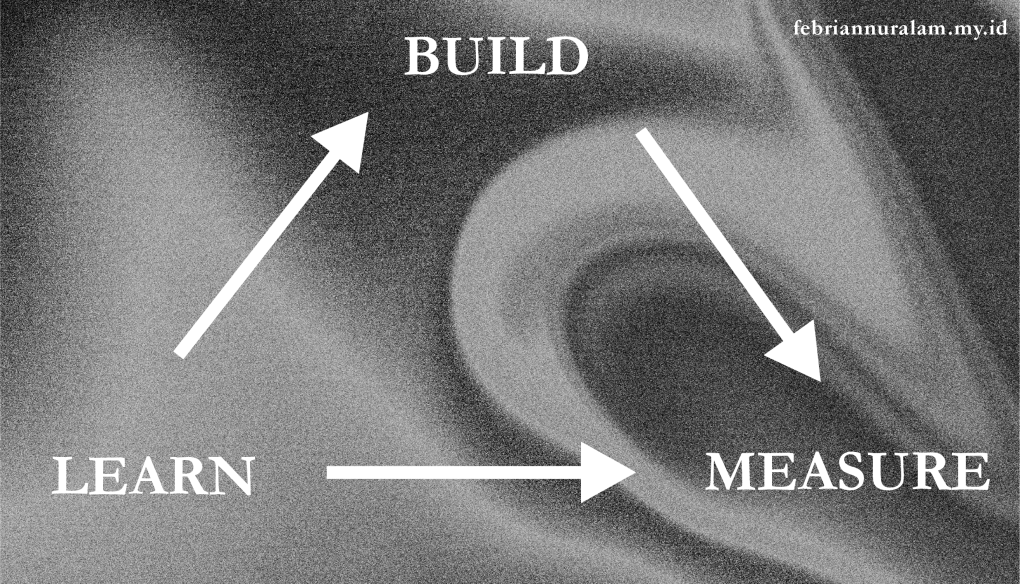
After you have a clear vision for your startup, it’s time to move on to the “steer” phase. We’ll explore the Build-Measure-Learn feedback loop and learn how to “pivot” to steer the startup we’re building. In this section, there are several key points to cover: Leap, MVP, Measure, and Pivot. The goal of steering is to minimize the time, money, and energy required to bring the product to the market. By getting the product out to the public as quickly as possible, any flaws in the product will be addressed and improved over time.
Leap
In this section, we will discuss the Leap of Faith Assumption (LoFA), or assumptions based on belief. Every business plan is fundamentally built on a number of assumptions that are often not explicitly stated. Whether in financial planning, distribution strategy, or product quality control, there is always a foundation of assumptions that serve as the basis for the development of the entire plan. These are things the founder believes but have not yet been proven.
There are two types of hypotheses: value hypotheses and growth hypotheses. A value hypothesis is an assumption that a product will provide value to customers after they use it. For example, “People will feel safer staying in a stranger’s home than in a hotel when traveling.” — Airbnb. A growth hypothesis, on the other hand, is an assumption about how new customers will discover our product.
Why are these two hypotheses important? If the value hypothesis is wrong, no matter how good your design is, no one will buy your product. On the other hand, if the growth hypothesis is wrong, we’ll have a hard time acquiring new customers.
MVP (minimum viable product)
Every startup is built on an unproven assumption, so how do we prove our assumption? The answer is an MVP (minimum viable product). An MVP is a product launched with as few features as possible. But enough to test whether there is a need for our product.
A good MVP is a product with limited features, but one that can provide a complete experience to customers in order to generate valid data. An example of a good MVP is Dropbox. When it was first launched, people were very unfamiliar with the concept of cloud-based storage. They created an animated video showing how users could upload their files to Dropbox, where they would be automatically backed up. Although it was just a video, this MVP successfully gave potential customers a general idea of the product.
Measure
After creating an MVP, the next step is to assess whether the product we’ve developed is making progress that will help us grow. If we create a product that nobody wants, all our hard work will have been in vain. This is where innovation accounting comes into play. Helping us determine which efforts are yielding results and which ones need to be optimized to achieve the best possible outcomes.
Innovation Accounting is an alternative accounting system designed specifically for startups. It’s a way to measure progress honestly and rigorously in conditions of extreme uncertainty. Where traditional metrics like revenue and user growth cannot yet be relied upon as indicators of success.
Pivot or preserve
In this section, we will discuss pivoting, which is a structured course correction designed to test new hypotheses about products, market segmentation, and business models. A pivot completes a full cycle of the build-measure-learn feedback loop.
If we realize that the product we’re selling isn’t needed by the market, sales are sluggish, and we can barely cover operational costs, then we’ll find ourselves in a situation where we’re neither thriving nor able to survive—a “land of the living dead,”. So to speak—where we’re scrambling for scraps of resources in a market that’s effectively dead. A pivot means we must test a new idea that requires a new MVP to be evaluated. A successful pivot can position a company for a sustainable business.
Accelerate
Now that we know which products are acceptable to the market. It’s time to move on to the next stage, where we’ll learn how to grow and develop quickly.
This section will be divided into several parts: batch, grow, adapt, and innovate. In the “accelerate” section, we will discuss how to manage work efficiently. Achieve sustainable growth, build an adaptive organization, and drive growth
Batch
Small batch is a concept taught by Toyota in which products are manufactured in small batches; rather than building 100 cars at once, Toyota chooses to build 10 cars, followed by another 10. Until the total quantity is met at that time, many factories other than Toyota used large batches to produce their products. But Toyota found that using large batches led to counterproductive results. They argued that using small batches resulted in more efficient production. Here are the reasons why small batches are superior to large batches.
- Instant error detection. In a large-batch approach, if a defect is found in a product that has already been manufactured, the entire production process must be repeated. In contrast, with a small-batch approach, defective products can be detected early on, eliminating the need to rework the entire batch of products that have already been manufactured.
- There is no backlog of inventory. In large batches, special storage space is required if a process has not been completed and is waiting to move on to the next step.
- Ease of detecting bottlenecks. In small batches, all processes run much more slowly. So when one process runs much slower than the others, it is easy to spot. In contrast, in large batches, bottlenecks are hidden among stages that are difficult to evaluate.
Grow
In this session, we will discuss three types of growth engines (methods for driving startup growth). These three growth engines are the sticky engine, the viral engine, and the paid engine
- Sticky engine (retention)
The sticky engine model relies on customer retention, where the rate of new customer acquisition must exceed the churn rate. If the number of new customers far exceeds the number of customers who leave, the company can grow. This model is well-suited for companies that use a subscription-based system.
- Viral engine (word-of-mouth)
The viral engine is driven by customers who bring in other customers. The key to the viral engine is the viral coefficient—that is, how many customers each customer brings in. If this number is greater than 1, customer growth will be exponential.
- Paid engine
The key to a paid acquisition strategy is how much a startup is willing to spend to acquire new customers—for example, through promotions, sales, and advertising. The main idea behind a paid acquisition strategy is to increase revenue from existing customers while reducing the cost of acquiring new ones. As long as Customer Lifetime Value exceeds Customer Acquisition Cost, the paid acquisition strategy can continue to be effective.
Adapt
Adapt will discuss how we adapt to change and build an adaptive organization by using validated learning to test products on a small scale, then analyzing the data to pivot.
To accelerate progress, the Lean Startup approach requires a process that generates feedback naturally. Running small batches, analyzing the data collected, and testing ideas takes significant resources and time. This can slow a startup down. Forcing things to move faster actually creates more problems. Once you’ve gone through this entire process, you’ll naturally move faster. To adapt effectively, we’ll explore the “Five Whys” method.
The “five whys” approach is a method developed by Sakichi Toyoda, who believed that behind every technical problem lies a human factor. The “five whys” method works by asking “why” five times in a row when addressing a problem.
When one of Toyota’s production machines breaks down, the technicians don’t immediately repair the machine; instead, they stop and ask, “Why did this happen?” Then. Based on the answer, they ask again, “Why did this happen?” They keep asking this question five times. Until they identify the root cause of the problem not just the surface level symptoms.
Conclusion
By studying the lean startup approach, readers can learn how to build a more resilient company to navigate the early stages of startup development. Such as using an MVP, implementing the Build-Measure-Learn feedback loop, and leveraging a growth engine. The lean startup approach has proven effective not only in technology-based businesses but also across a wide range of industries. It is a proven method for helping to create viable products for a market that is already waiting.
Also read: Book Review Series: “Sapiens: A Brief History of Humankind”