Abstract
Back in elementary school, I was once told about a theory of human evolution that claimed humans actually descended from monkeys. My first reaction was, ‘Come on, why do people compare humans to monkeys?’ No way. But after reading this book, I learned a few things: first, Charles Darwin never said that humans descended from monkeys. Second, whether we accept it or not, humans basically treat other animals in the same way.” In fact, in some studies, we use animals to determine the behavior patterns of humans. Finally, compared to other species. Homo sapiens have only been on Earth for a very short time. Yet the impact we’ve had is far greater than that of any other species—it’s incomparable.
The book is really a lot of fun to read; the writing style is incredibly fluid—it doesn’t read like a book written by a professor, even though the author is indeed a professor. However, some people have criticized this book because they believe parts of it are inconsistent with historical facts. Especially regarding the Middle Ages. Still, despite the criticism—which I think remains reasonable—the book is written for a general audience, so the author simplifies certain ideas to make them more accessible to a wider readership.
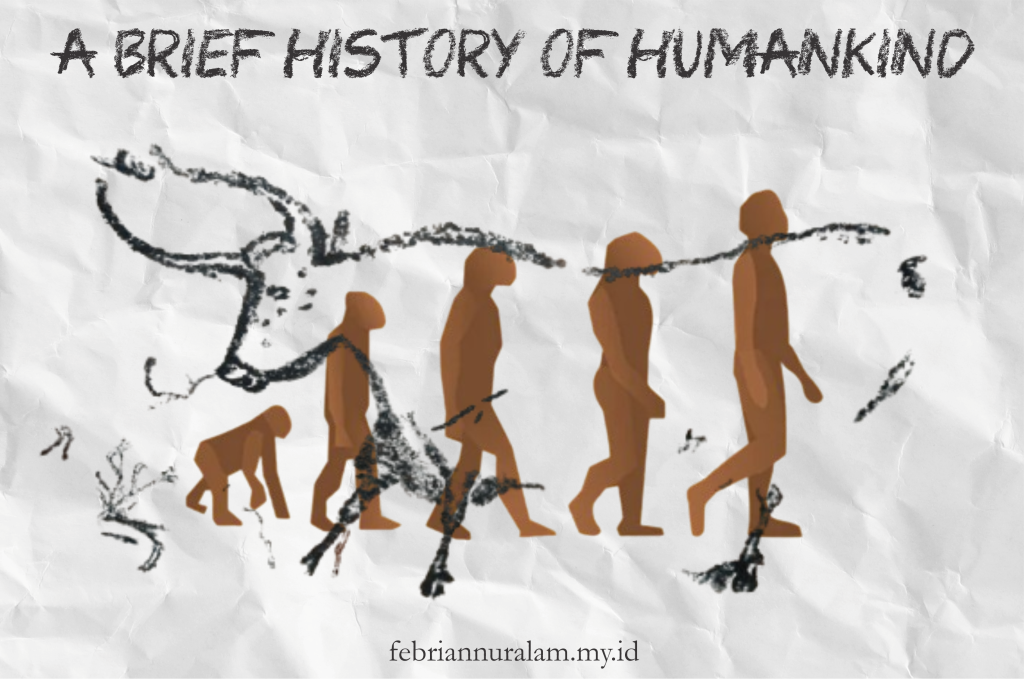
Who were the ancestors of humankind?
Disclaimer: I will refer to the species as Homo sapiens, because throughout human evolution, several species have been potential ancestors of modern humans. These include Neanderthals, Homo wajakensis, Homo soloensis, and many others. After a long evolutionary process, Homo sapiens prevailed and became the ancestors of modern humans.
Getting back to the topic, what exactly is this book about? As mentioned earlier, humans are actually a relatively new species on Earth compared to others. Yet, for some reason, we’ve become so influential that we can even determine the course of life for other species inhabiting the planet. Physically speaking, though, humans aren’t that strong. Our hands weren’t made for destruction, our jaws aren’t as strong as a crocodile’s. Our legs aren’t as strong as a horse’s, which can stand the moment it’s born. Other species can fend for themselves within days, while we need years to be raised by our parents just to be able to walk. It doesn’t quite make logical sense how this weak species could determine which other species are worthy of living on Earth.
According to the author, there are four factors that explain why we have become such a dominant species. The first is our free hands, the second is linguistic flexibility, the third is our ability to cooperate in large groups, and the fourth is our ability to create fictional stories.
Free hand
If we go back to the hunting era, roughly 2.5 million years ago, humans spent their time solely on hunting—though not necessarily every day. In fact, there’s a theory that Homo sapiens at that time hunted only once every four days. The game they caught could feed a small group for several days. Keep in mind that the animals back then were very different from the animals we have today. There used to be massive mammoths and saber-toothed tigers whose teeth alone could slice through meat just by gnawing. But Homo sapiens were able to defeat them. What exactly set Homo sapiens apart? What were Homo sapiens’ weapons?
It turns out that Homo sapiens ability to walk on two legs has provided a significant advantage to the species. Walking on two legs frees up both hands to perform activities other than walking. In other species, animals use their hands as tools to help them walk.
With two free hands, Homo sapiens had additional tools to arm themselves, such as spears, sticks, stones, and ropes. Using a wide variety of combinations, Homo sapiens were able to adapt to the various species they hunted. And with these varied weapons and their numbers, Homo sapiens were able to conquer other species.
Language flexibility
There are many species other than humans that can communicate. Parrots can mimic our voices, and some studies even claim that Madagascar lemurs can communicate with their group. They make specific sounds to signal a threat from below, and the monkeys will make a different sound if the threat is above them. However, some mischievous monkeys will tell their group that a threat is directly beneath them, causing the group to flee and leave the monkey alone. It turns out there is an plentiful food source not far from there.
Homo sapiens is not the only species that communicates. What sets Homo sapiens apart from other species is the flexibility of the language they use. Homo sapiens can convey highly complex information. For example, across the river there are three tigers—two males and one female. They are sleeping right beneath a large tree next to a food source. With this information, a group of Homo sapiens can coordinate to formulate the best attack strategy or avoid hunting in that area.
During the hunting era, Homo sapiens were already capable of making fire; they lived as nomads. When an area was no longer considered productive, they would clear a new forest to establish a settlement. If that area later became unproductive, Homo sapiens would clear another piece of land. This cycle continued continuously. Homo sapiens obtained food through hunting, and their catch could generally last for three to four days. Imagine if a group of Homo sapiens slaughtered a goat—the meat would last for a very long time. During this waiting period, Homo sapiens developed a skill that sounds silly but was very influential in the development of this species. That is, gossiping. Yes, you read that right—it turns out that the skill of gossiping can be so influential that it can lead us to become a truly superpower species!
Cognitive revolution
While waiting for the next hunting session, Homo sapiens would gather to gossip. They discussed many things, ranging from their daily lives to which members of other groups had been sent as spies to destroy their own group. And they developed better strategies for hunting the mammoth that had escaped a few days earlier. Compared to other species, Homo sapiens’ ability to communicate was on a completely different level. It is so deep and complex that, fundamentally, the main cause of this intelligence surge remains unknown. People also refer to this surge in intelligence as the Cognitive Revolution. From the inception of the theory of human evolution to the present day. Scientists cannot explain with certainty what caused the surge in intelligence experienced by Homo sapiens. This complex ability to communicate provided a solid foundation for Homo sapiens to build upon.
Ability to collaborate on a large scale
Cooperation is the factor that has enabled Homo sapiens to thrive on this planet. But make no mistake: ants cooperate, termites cooperate, and bees cooperate as well. Other species cooperate because it is their nature, whereas Homo sapiens cooperate by their own choice. We can look at ants as an example; within an ant colony, there are several distinct roles. These include worker ants, soldier ants, and the queen ant. To become a queen ant, you must be born as one.
A worker ant cannot become a queen ant, no matter how hard she works or how often she dreams of becoming a just queen for the ant colony. This is due to unavoidable biological limitations. There are genetic factors that cannot be changed. The ant queen’s behavior is so strictly determined by her DNA that she can only be fertilized and lay eggs. Everything that happens is completely predetermined by a sequence of DNA.
Homo sapiens also cooperate in different ways; they do not need specific DNA to coordinate with one another. A group leader can be removed by members of the group who are dissatisfied with their performance. In addition, Homo sapiens can build networks of cooperation on a much larger scale than other species.
We often hear that some groups frequently split up due to differences of views. This problem isn’t only found in modern society; Homo sapiens face the same issue. If a group becomes too large, friction naturally arises, leading to the formation of smaller subgroups. So, what is the maximum number of people that humans can maintain while still cooperating effectively?
The maximum capacity for human collaboration
According to Robin Dunbar’s theory, the maximum number of people who can cooperate and maintain a social structure is 150. And don’t get the wrong idea—this theory doesn’t just apply to Homo sapiens, our ancient ancestors; it also applies to modern humans like us. This principle is also applied in the military, where a platoon consists of a maximum of 50 people. In a marketing division, it’s certain that the number of people won’t exceed 150. If a community organization consists of thousands of people, that number will be divided into several groups.
Large group sizes have many disadvantages, including slow information distribution, which in turn leads to slow decision-making. The organization will become unstable due to excessive friction among members. In short, it is virtually impossible for humans to maintain a social structure with an excessively large number of members. So, is this the limit of Homo sapiens’ capabilities? Can Homo sapiens only cooperate in groups of 150? The answer is no; Homo sapiens developed further capabilities. These capabilities have enabled Homo sapiens to become the species that governs this Earth—deciding where rain falls and which species survive. All of this is regulated by these capabilities.
Inventing and believing in fiction
Some of us may be lucky enough to have our parents read us a bedtime story before we go to sleep—stories like “Timun Mas,” “Bawang Merah – Bawang Putih,” “The Three Little Pigs,” and many more. Through these stories, our attitudes are subtly shaped and gradually ingrained into our subconscious. We are taught moral boundaries—what is good and what is bad—through bedtime stories. Of course, over time, we learn that lying is wrong, while helping others is a good deed. All of our behaviors are gradually shaped by the lines of text woven into a story.
Fiction all around us
Communities around us have deeply ingrained many legends and traditions into everyday life. People say, ‘Don’t throw stones at that tree or its guardian spirit will get angry,’ ‘Don’t eat in front of the door or your soulmate won’t come,’ and ‘When sweeping the floor, make sure it’s clean—otherwise your future spouse will be bearded,’ and so on. If we ask the people who tell us these things, their answer will surely be something like this: “Well, I don’t really know—my grandparents have always said that, so just follow what your elders say.”
For my generation, in general, any folklore with no scientific basis is just nonsense. Honestly, I’m tired of seeing people turn simple things into something unnecessarily complicated. In the name of respecting tradition. But whether I like it or not, I have to admit that creating fiction and believing in it helps solidify social structures.
Through fiction, humans can cooperate in numbers far beyond what we might expect. The limit described by Robin Dunbar—who argued that humans can only cooperate with about 150 people—seems meaningless when humans believe in a fictional narrative. Fiction helps humans cooperate in numbers that exceed our social limits; forget 150—thousands, hundreds of thousands, millions, or perhaps hundreds of millions of people can cooperate provided they believe in the same fiction. Because fundamentally, as long as Homo sapiens believe in the same fictional narrative, they will adhere to the same rules and can cooperate very effectively.
Fiction that has become an integral part of our daily lives
When I talk about fiction, readers might think of the troublesome traditions their parents passed down to them. But don’t misunderstand, fiction is so deeply woven into our lives that we often fail to realize how much we depend on it. Money, economic systems, limited liability companies, and even nations themselves exist because society collectively believes in these shared fictions.
Only humans can collaborate collectively in large numbers based on a shared vision. Someone working at a startup works tirelessly to bring the business they’re building to life—does this company actually exist? Physically, it doesn’t, but people can work together to help the company grow.
One of the most successful fictions created by humans is money; just take a look at the money in your pocket. Now, be honest with yourself: does a piece of colored paper really have a value of, say, one hundred thousand rupiah? Financial institutions have successfully convinced us that this piece of paper holds the same value as the number printed on it. Everyone works together on a regular basis to earn money, because they believe that money is valuable.
The conclusion of this book, clearly articulated by Yuval Noah Harari, is the reason why Homo sapiens have become so dominant on Earth. The reason why we can dictate the course of development for other species on Earth. It turns out the biggest reason is that we can cooperate collectively in large numbers. With this ability, we can set foot on the moon, grow crops in arid deserts, clear out tropical rainforests, and much more.
Also read: Working with data