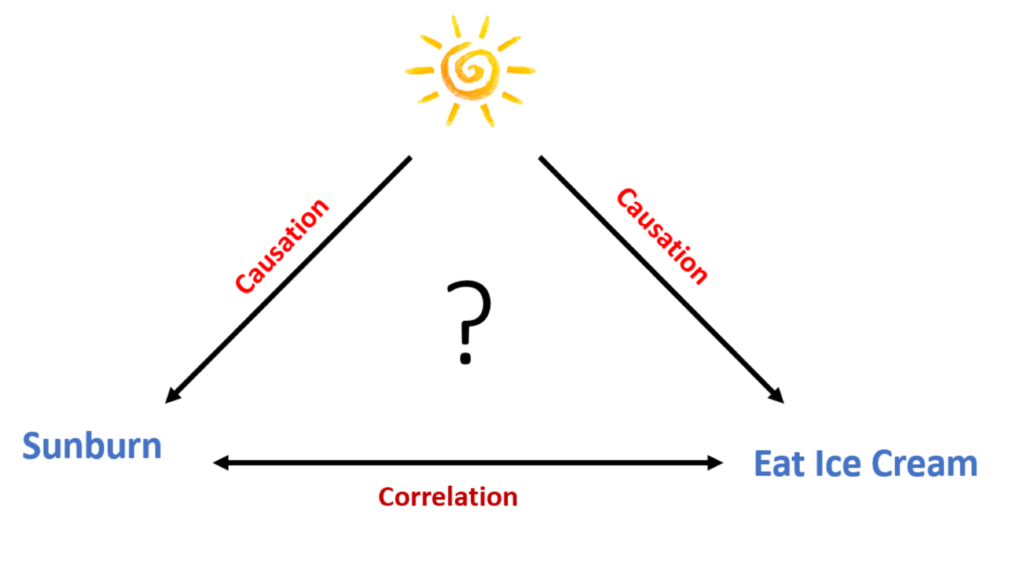
You have probably heard at some point that “Correlation is not causation” most likely from someone looking at data that posed a challenge to parts of his worldview that we were reluctant to question. Nonetheless, this is an important point if x and y are strongly correlated, that might mean that x causes y, then y causes x, that each causes the other, that some thirty factor causes both, or nothing at all.
The general opinion in society is correlation and causation is the same thing, this is because the human mind likes to find explanations for seemingly related events, even when they do not exist. We often fabricate these explanations when two variables appear to be so closely associated that one is dependent on the other. That would imply a cause-and-effect relationship, where one event is the result of another event.
Let me give you a little example to help you understand the difference between correlation and causation. Now imagine you are on the island of Bali at 1pm you can feel the heat of the sun hitting your skin. Now imagine that you are basking in the sun with a vanilla ice cream. How delicious would that be LOL. In this example, there’s a correlation between eating ice cream and getting sunburned because the two events are related. But neither event actually causes the other. Instead, both events are caused by something else—sunny weather.
Correlation tests for a relationship between two variables. However, seeing two variables moving together does not necessarily mean we know whether one variable causes the other to occur. This is why we commonly say “correlation does not imply causation.”
Importance of correlation and causation
The objective of much research or scientific analysis is to identify the extent to which one variable relates to another variable. For example:
- Does increasing income affect the level of education
- Do cigarettes really cause cancer?
- Has your advertising had an effect on your sales increase over the past few months? Or is it caused by something else?
These and other questions are exploring whether a correlation exists between the two variables, and if there is a correlation then this may guide further research into investigating whether one action causes the other. By understanding correlation and causality, it allows for policies and programs that aim to bring about a desired outcome to be better targeted.
How can we measure a correlation?
Hypothesis testing
Hypothesis testing, sometimes called significance testing, is an act in statistics whereby an analyst test an assumption regarding a population parameter. The methodology employed by the analyst depends on the nature of the data used and the reason for the analysis.
Used hypothesis testing to assess the plausibility of a hypothesis by analyzing sample data.. Such data may come from a larger population or a data-generating process. We will use the word ‘population’ for both of these cases in the following descriptions.
A/B/n Testing
A/B testing is a practical application of hypothesis testing. We use this method to compare two versions of a product or feature to determine which one performs better.. This involves showing two variants to different segments of users simultaneously and then using success and tracking metrics to determine which variant is more successful.
We need to fine-tune every piece of content a user sees to achieve its maximum potential. The process of A/B testing on such platforms mirrors hypothesis testing.
If you enjoyed this post on Correlation VS Causation, feel free to get in touch with me (Febrian Nur Alam) regarding any thoughts or queries!
Read More: The Simpson Paradox